
ROYALLY IMPRESSED: The Royal Enfield Lifestyle
- Mark Policarpio

- Jan 16, 2021
- 5 min read

For the last 100 years, motorcycles have carried the reputation of being mischievous. From the famous Harley Davidson Wrecking Crew taking wins in flat-rack racing in the early 1920s to the violence of the Japanese Bosozoku biker gangs in the 1950s, and even today with biker gangs taking over streets and highways, motorcycle culture has long been associated with hooliganism.
Even bikes as seemingly sedate as Royal Enfield have an air of mischief about them, though not the violent kind.
Having its roots in pre-war Great Britain, Royal Enfield started making motorcycles in 1901 by simply bolting an engine to a bike frame. Such was the scene in the early 1900s, when the concept of a “motorized bicycle” was the stuff of science fiction. Yet here they were, doing things that had never been done before. Unfortunately, the Royal Enfield company went bust in 1971 because of severe mismanagement, the proliferation of the Japanese motorcycles and sheer bad luck.
However, someone clearly forgot to tell the Indians that.
STARTING (AND STICKING) WITH THE BASICS

Since 1955, Royal Enfields have been in continuous production in India. It started with a partnership between the British Royal Enfield company and Madras Motors. The latter was licensed to assemble the 350cc Royal Enfield Bullet under the name “Enfield India.”

When the British Royal Enfield closed up shop in 1971, Madras (now Chennai) Motors continued to build the Bullet 350 and 500, and do so until today. In 1994, Royal Enfield (no longer Enfield India because, well, they were free to use the name since the original company folded) merged with the Eicher Group, another automotive company in India.
So much like traditional Indian Curry, Royal Enfield is a mishmash of ingredients that, taken alone, wouldn’t be entirely appetizing. But it’s exactly that mixture of strange ingredients that makes curry amazing.
And the same is true of Royal Enfield – a hand-me-down name that makes a motorcycle designed in the early 1950s using a mix of traditional and modern techniques. It’s a recipe that shouldn’t work. And yet, in 2015, more people bought Royal Enfields than Harley Davidsons. That’s because just like curry, Royal Enfields have a lot of kick and are full of flavor.
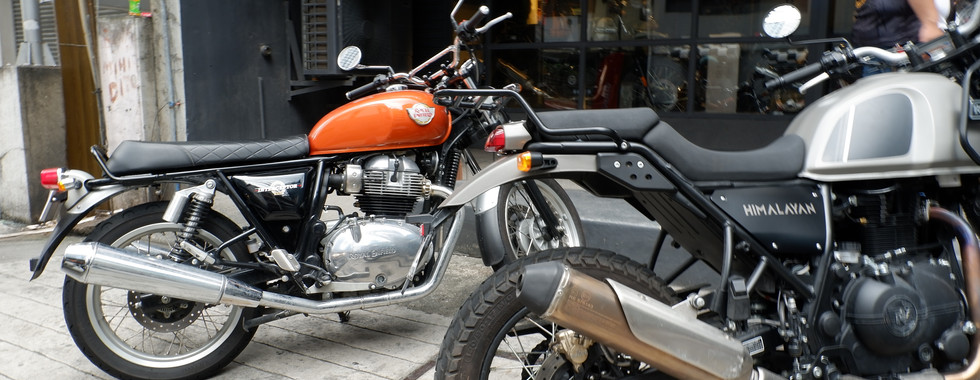
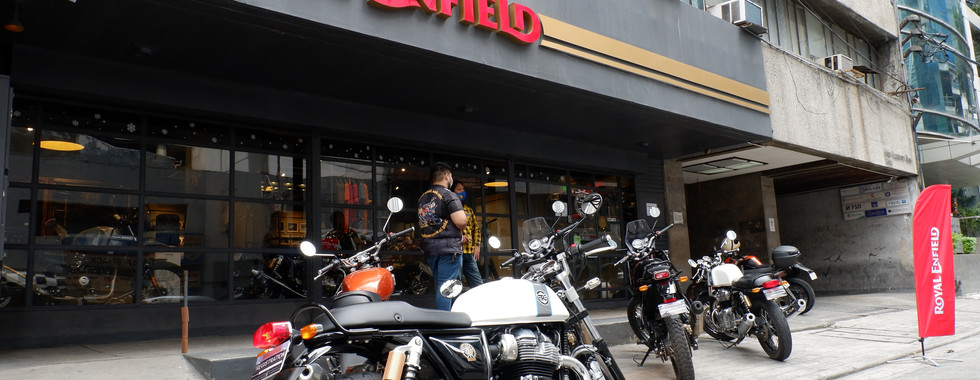
I had the pleasure of sampling Royal Enfield’s products for a morning at their showroom in Makati City, Metro Manila – in particular, the Himalayan and the Continental.
BLESSED BY GANESH

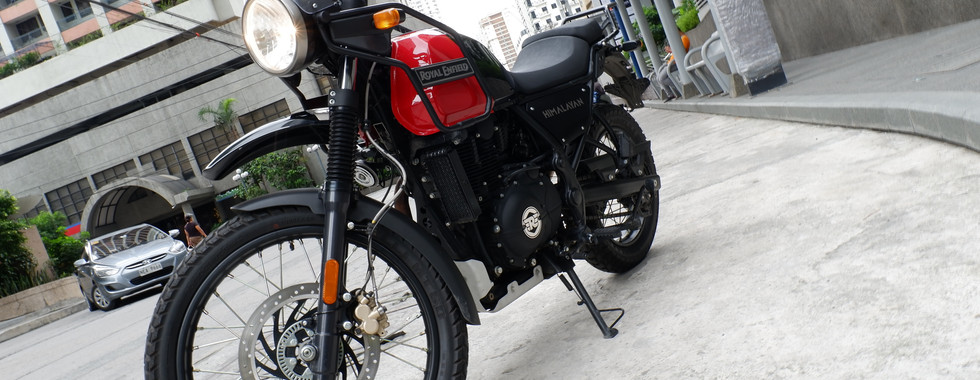
The Himalayan, Royal Enfield’s take on an adventure bike, is powered by a 411cc single-cylinder, air-and-oil-cooled engine with a five-speed manual transmission. With less than 26 horsepower, the Himalayan isn’t as powerful as its rivals, specifically the KTM 390 Adventure. It’s also fairly heavy at 191 kilograms.

But the Himalayan is surprisingly agile. Once it got moving, the weight aided in turns by naturally leaning the bike with your movement. Save for the weak brakes, the Himalayan could be considered spritely for its weight and power. I think that underscores the bike’s main purpose.
You see, many are called adventure bikes because of their specifications. For KTM’s 390 Adventure, it’s the off-road tires, the high exhaust mount and the generous ground clearance. But few bikes can truly be called adventurous, with the sole exception being the BMW GS series of bikes that were taken around the world in the now-legendary series called the Long Way Round.

For many adventure bikes, the definition of “off the beaten path” is some form of dirt or washboard road in the boondocks. Not so with the Himalayan, which gets its name partially from the Himalayas, and partially from the fact that it can reach the Northern Face of the most famous of these peaks, Mount Everest.
If there were ever a motorcycle that deserved the definition “go-anywhere,” the Himalayan is worthy of it. The 411cc engine may be underpowered, but it makes up for it with torque, which is the all-important metric in off-road riding. It’s what makes your bike capable of climbing almost any terrain and maintaining your momentum even when Mother Nature would rather you stay horizontal. The extra heft that the Himalayan packs also means it’s very stable over rough terrain, often ironing out bumps that lighter bikes would be put off by. And the solid steel girder they call a frame means the bike can take a beating, get back up and ask for more.
The Himalayan feels like it will get you through to the end of the world and keep going even after you’re gone.

THE OL’ ONE-TWO

If we move to the other end of Royal Enfield’s spectrum, we have the 650 Twins, as they’re affectionately called – the Continental and the Interceptor.

With their 647cc parallel twin engines, these bikes are definitely a few clicks faster than the Himalayan because they have nearly double the power and torque. I had the pleasure of riding a slightly lowered Continental and immediately felt the difference in power.
Where the Himalayan was slow but surefooted, this was fast and slightly frightening at first. But once I got used to the extra heave, the Continental transformed from beast to beauty, almost goading me on to twist the throttle even more. The torque of the parallel twin accelerates the bike so quickly that I would brake almost immediately because of the approaching stoplight.

It’s heavier than the Himalayan, though, at 202 kilograms. Yet the bike itself feels even more nimble in corners and more sure-footed in braking. Chalk it up to the seating position and possibly better suspension.
A ROYAL (ENFIELD) FLUSH

Definitely, these Royal Enfields carry the aura of mischief that all bikes have had since their inception.

The Himalayan taps into your desire of adventure – going out, playing in the dirt and coming home with your clothes all muddy. It’s the right tool not just for going off the beaten path, but also for finding a path of your own. Meanwhile, the Continental has a sense of refined mischief, if there were ever such a thing. It will poke you, prod you and annoy you until you finally give in and let it loose. Despite admitting defeat, you know deep down that you’re going to feel excitement in every turn, even if you take it at safe speeds.

Besides curry, Royal Enfield embodies another aspect of its adopted Indian culture – Nirvana. It’s the idea that what feeds the body – money, power and possessions – pale in comparison to what feeds the soul – freedom, tranquility, knowledge and wisdom.
These bikes remind you that there are more important things in life: enjoyment, fulfilment, adventure, wanderlust and peace.














Written by: Mark Policarpio
Edited by: Froilan Victor Jr. Bacungan

Comments